
Cradle Mountain - Lake St Clair
 Half a day to several days bushwalking
 Mixed sun and shade
 Alpine dolerite, up to 400m high
Acknowledgement
The Mt Geryon section is by Matt Perchard, originally published in Craglets. Some route descriptions from original CCT circulars, Chris Baxters 1984 Geryon Guide, Rock New Climbs 1997 by Rod Young, and Climb Northern Tasmania by Bob MacMahon and Gerry Narkowicz. The Cradle Mountain section and other material is from Tony McKenny, Ross Taylor, John Chapman, Nic Deka, Bob Hamilton and Steve Brown.
Introduction
The Cradle Mountain-Lake St Clair National Park forms part of the Tasmanian Wilderness World Heritage Area and is traversed by the world-famous overland track, a multi-day bushwalk about 80km long. At the north end, the jagged contours of Cradle Mountain dominate the skyline, while to the south is the deepest lake in Australia, Lake St Clair, carved out by ice during several glaciations over the last two million years.
The weather in this area is at its most stable during late summer and autumn. The Park receives a lot of rain annually, and sleet, snow and driving winds can occur at any time of the year. Check the weather forecasts at the Visitor Centres or by contacting the Bureau of Meteorology prior to departing (www.bom.gov.au).
If you want to walk right through the Park, bookings are required (1 October to 31 May) and during that period walkers are required to walk the track from North to South. However, if you access the track at other points or are only travelling part way along it, no bookings are required but Park fees do still apply. For further information see:https:https://parks.tas.gov.au/explore-our-parks/cradle-mountain/overland-track
Climbing in the Park can only be described as undeveloped. If you want a wilderness climbing experience there are many cliffs of all sizes still to be explored. However, climbers are asked to respect the wilderness ethic and to stick to the principles of minimal impact bushwalking and climbing (no bolting for example). The WHA is also a fuel-stove only area.
History
Gustav Weindorfer, the founder of Waldheim and the main driving force behind the declaration of the area as a National Park, first climbed Cradle with his wife Kathleen in 1910, some 82 years after the probable first ascent by Joseph Fossey. Over the next few years Weindorfer climbed all over the mountain, making the first winter ascent in 1924 with Charles Monds and Fred Smithies from Launceston. Fred founded the Northern Tasmanian Alpine Club and in the 1920s and 30s they ascended many of the gullies and faces, and specialised in daring jumps from pinnacle to pinnacle. The first recorded traverse of the full skyline, from Little Horn to the Summit, was made in 1914 by visiting Austrian mountain guides Franz Malcher and his brother Julius, an ascent that must rank as probably the first recorded rock climb in Tasmania and possibly in the country.
Years later, Ossie Ellis, an ex-saw miller turned mountaineer and conservationist, co-built Pencil Pine Lodge (now Cradle Mountain Lodge) and kept open house in the 1970s and early 80s for another generation of young climbers, mainly drawn from the north west coast. Bevis (Fred) Dutton and Steve Brown along with John Richardson, Robert (Bird) Hamilton, Nick Williams, (the chef at the Lodge), Tony McKenny, Nic Deka and Neale Smith made the hill their own, adding a number of exploratory rock climbs and hacking up and down the gullies and buttresses in winter. The area has also been a playground for cross-country skiers, with the most noticeable ski descents to date being those of Kim Robinson and Ian Wilson in 2003 who skied down the precipitous eastern (Rodway) face of the mountain. Bird Hamilton has the record for the fastest descent, however, when he fell down the gully behind Little Horn, travelling 200+m on snow and exiting with a bent crampon as the only damage. "The fall is etched in the memory! Very clear recollections of long periods of sailing through the air interspersed with thuds into the snow during the later part of the excursion! Only injury other than being a bit winded was I split the skin on the point of one hip, no big deal, I was expecting more..."
Mind you, it is not beyond the realms of possibility that the first ascent of most climbing routes in the Park may well have been made previously by Galaxias brevipinnis, the extraordinary Climbing Galaxias, a fish found in tarns in the area with large fins and capable of climbing damp rocks...
Access
Permits are required to access some of the overnight camping sites in the park that are used by climbers - in particular pine valley hut and Scott Kilvert. Please review the PWS websites for more details.
https://parks.tas.gov.au/explore-our-parks/know-before-you-go/overnight-walker-registration
North End
Cradle Mountain is about 1.5 hours (85 km) from Devonport. Take the B19 to Spreyton then the B14 through Barrington to Sheffield and then follow the C136 to Cethana continuing on till the C132 junction at Moina. Follow the C132 south for 19 km to the signposted turnoff to the park. From Launceston it is a 2.5 hour drive (181 km). Take the Bass Highway (A1) toward Devonport, then follow the signposted route via the B13 and C156 through to Sheffield and on to the C132.
Park passes allow entry to all Tasmanian parks but specific daily passes are available for entry to Cradle Mountain and can be purchased from the Cradle Mountain Visitor Centre.
Private vehicle access into the park is now severely restricted and only permitted before 8.00am and after 6.00pm in summer, outside of the daily shuttle bus operating hours. Limited parking is available at Waldheim & Ronny Creek. For condition advisories and more information, contact the Cradle Mountain Visitor Centre on 03 6492 1110.
From November 2023, fees also apply to use the Cradle Mountain shuttle bus for adults 18 years and over. Shuttle bus tickets can be purchased at the Cradle Mountain Visitor Centre. Options include;
• A 24 hour shuttle bus ticket - Included in the cost of a Cradle Mountain Day Park Pass.
• A 72 hour shuttle bus ticket - $15.00 per adult.
• An annual shuttle bus pass - $45.00 per adult.
Cradle Mountain shuttle bus tickets are not transferrable and must be used in conjunction with a valid parks pass.
For further information contact:
https://parks.tas.gov.au/explore-our-parks/cradle-mountain
South End
Lake St Clair is about 2.5 hours (180 km) north-west of Hobart. Take the A10 (Lyell Highway) to New Norfolk and on to Derwent Bridge. Turn off here and travel the last 5km to the national park entrance. From Launceston it also about 2.5 hours (180km) to the park. Take Route 1 direction Devonport turning off to the A5 at Deloraine. Take the partly unsealed A5 over the Central Plateau to the Great Lake and Liawenee. 10km after Liawenee take the unsealed B11 past Bronte Park until you reach the A10. Turn west and drive a further 26km to Derwent Bridge and the turnoff to the park.
There is no direct road link between the two ends of the park. Tassielink (62717320 or 1300300520) runs bus services to/from both ends all year round and a ferry runs between Cynthia Bay at the southern end of the Lake and Narcissus Hut at the other end (03 62891137).
For further information:
* TASMAP 1:25,000 map
* Cradle Mountain Day Walk Map & Notes 2000
* Lake St Clair Day Walk Map & Notes 1997
* 1:100 000 Cradle Mountain-Lake St Clair Map & Notes 2001
* "Cradle Mountain Lake St Clair & Walls of Jerusalem National Parks" by John Chapman is the best bushwalking guidebook
* Cradle Mountain Visitor Centre - Ph: 03 6492 1110
* Lake St Clair Visitor Centre - Ph: 03 6289 1172
* http://www.parks.tas.gov.au/
Camping
North End
Camping is not permitted in the day use area around Dove Lake and Cradle Mountain itself but there are commercial campsites close to the Visitors Centre as well as hotels and restaurants. The only accommodation available within the Park is at the Waldheim Chalets (book through the Cradle Mountain Visitor Centre) or at the various huts dotted along the Overland Track.
Use of these huts is generally restricted to walkers on the Overland Track only, except for the hut at Lake Rodway, and a tent should be carried. Fees apply, currently @285 per adult (2023), if you want to walk through the Park from 1 October - 31 May inclusive.
Concessions do apply but facilities are generally full then.
See https://www.parks.tas.gov.au/index.aspx?base=27902 for full booking and access details.
South End
At Cynthia Bay there is a back-packer/ travellers hostel and camping sites. Bookings are essential in the summer season (03 6289 1137).
Crag Steward
Rock climbers please contact the Cliff Steward (southwest@climbersclubtas.org.au) if you have any queries or concerns regarding social or environmental impacts of rock climbing at this crag. Do not email regarding general travel, seasonal advice, or lost property - this is not the Steward’s role. If you have important safety information to communicate (e.g. risks due to recent and large rock falls) please also consider updates on thesarvo forum, facebook group and/or online guidebooks as appropriate. Please copy in cct@climbersclubtas.org.au if you feel you have a high level concern which may imminently impact the crag or climbing community.
Non-climbers, other users, land managers: please also contact cct@climbersclubtas.org.au if you have important climbing related queries at this location.
GPS
Cradle Mountain Area
Intro
The steep and jagged profile of Cradle Mountain is one of the iconic images of Tasmania and the most popular (and publicised) destination for visitors interstate and from around the world. Ice has ground and gouged out deep valleys and left soaring dolerite spires and knife-edge arêtes. This is the domain of the mountaineer rather than the rock climber as on closer inspection the columnar dolerite proves to be rather broken and the lower quartzite cliffs are often difficult to reach in thick, steep scrub. The weather can be continuously lousy too but in a good winter the world transforms and, in the right conditions, it can all get quite exciting.
Access
The start of most walking tracks is either at the Ronny Creek Car Park in Cradle Valley, about five km south from the Park's information Centre or a kilometre further on down the road at the Dove Lake Car Park. It is probably best to use the shuttle bus as there may not be any available parking space actually in the Park but check the time of the last bus if you are planning a long day. Climbs are described from L to R, clockwise, round the Lake.
Pencil Pine Buttress
GPS
This small quartzite crag is actually located just inside the Park boundary, before you reach Cradle Valley. Drive to the old Interpretation Centre passed Cradle Mountain Lodge on the right, and leave your car in the public car park before the main boom gate. Walk a couple of hundred metres passed the gate towards the mountain and just after Stony Creek (signposted - GPS CRA100) an old track leads off left through button grass towards the crag. The path enters a scrag of forest and just past the first low lichenous wall is a long continuous corner, the line of Ossie's Climb. The crag was first climbed on by a legendary NW climber, Ossie Ellis. Ossie was a co-founder of what is now called Cradle Mountain Lodge. A saw miller by trade, he was a keen conservationist in later life and a late but dedicated convert to rock climbing and mountaineering. There are two climbs to date but there are lines still crying out to be done. Descend by abseil (tape) or by walking back off to the south.
Climbs the dirty corner, curving R at the top.
Ossie Ellis, early 1970s.
Continue on round the base of the cliff and take the RH branch past steeper, clean walls to a wide bay with a stunning, overhanging wall to the right and an equally attractive wall to the left, split by a chimney between them (GPS CRA110).
Up short, dirty wall on the L, and walk R along the ledge to the corner. Climb the corner into the chimney, and continue up until forced out to crack above. Follow to top. A recent rockfall high up to the right may have destabilized some of the summiting rocks - take care!
Tony McKenny and Steve Brown, 1978. FFA Nic Deka and Neale Smith, 1979
Hansons Peak
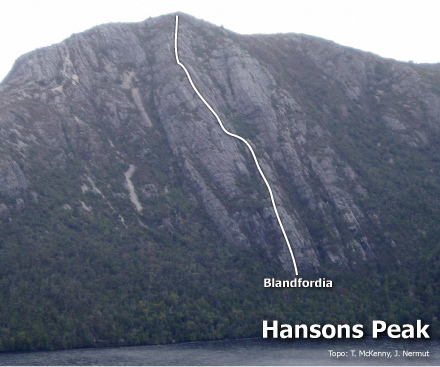
Located on the east side of Dove Lake, Hansons Peak has an impressive sweep of slabs reaching nearly to the summit. On closer inspection, however, the quartzite rock proves to be rather broken but still offers some interesting slab climbing with great views over the lake to Cradle Mountain. From the Dove Lake carpark, take the Lakeside Track eastwards for about a kilometre until just opposite, or a little past, Marions Lookout. Cut up to the toe of the slab through the rain forest… descend by the Hansons Peak track.
Takes a meandering line up the most continuous section of rock, finishing just below the summit.
John Richardson and Tony McKenny, 1977.
Little Horn
The north face of Little Horn offers some scope for relatively easily accessible short climbs. Peter and Roger Booth wandered over the area in the early 80s but there is only one recorded line to date.
B. Cassimatis, P. Davies April 1985, although possibly climbed earlier.
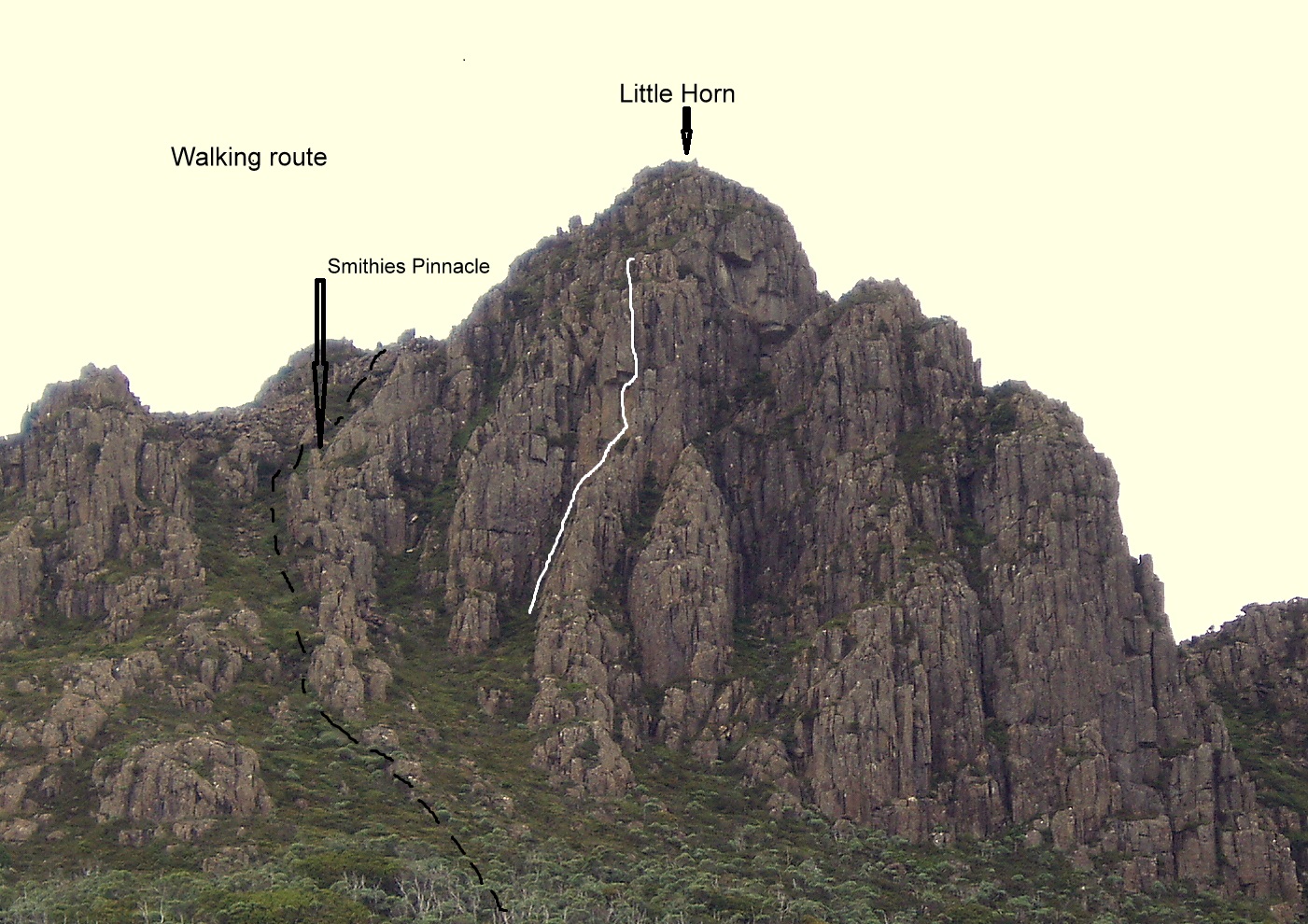
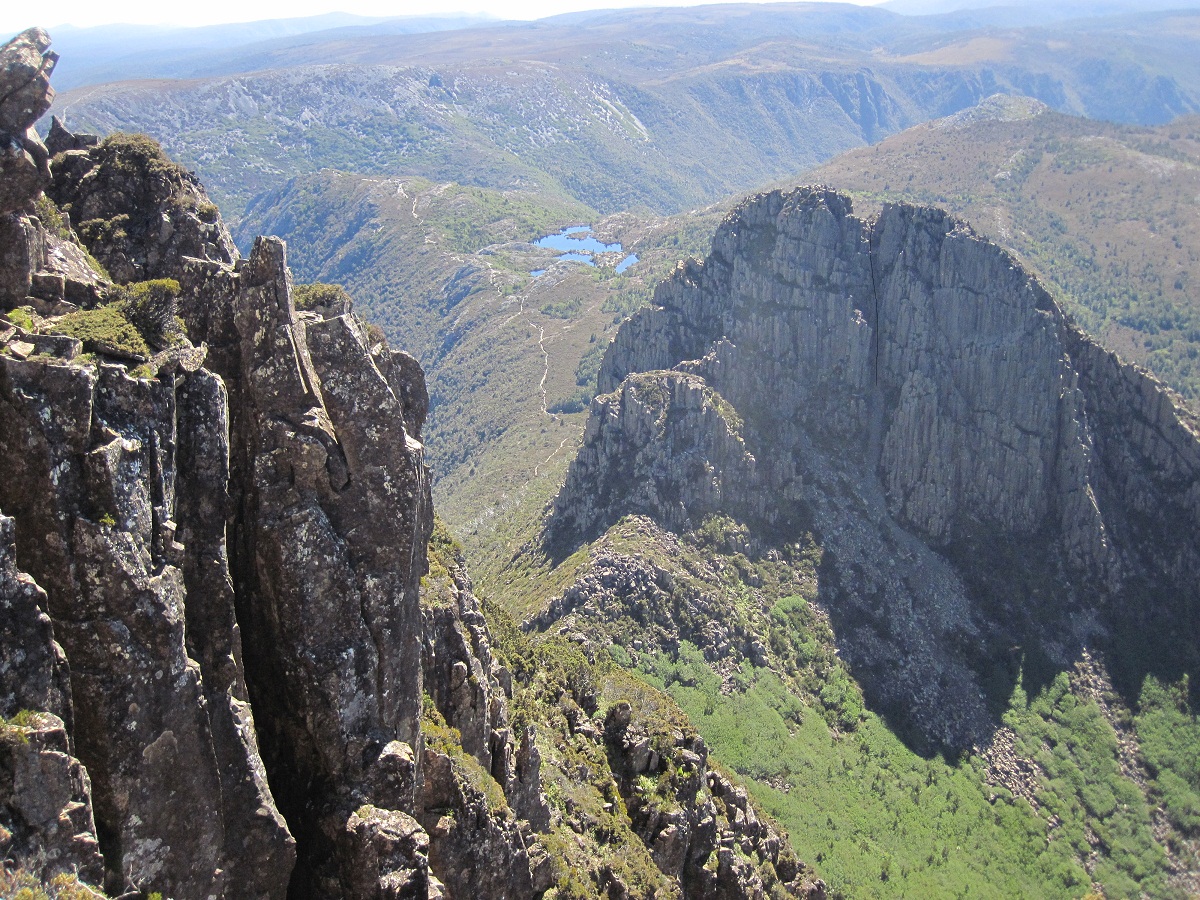
On the Rodway Face, looking towards the west (marked by black line on photo above) , the main gully system above the talus slope was climbed by Cassimatis and Davies in March ‘84 in 3 pitches, the first about Grade 8, the second a bit harder with a Grade 12 move near the top, finishing up an easy (Grade 5-ish ) gully.
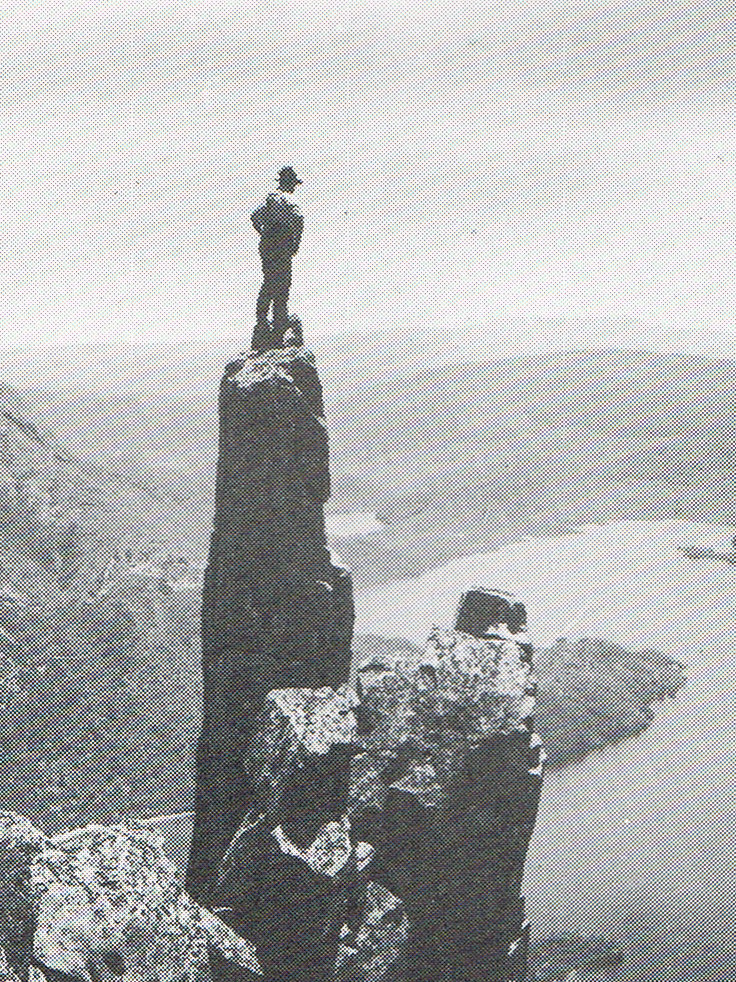
Worth a note is Smithies Pinnacle, a prominent finger of rock beside the main walking track on the NE ridge of Little Horn. First soloed in the 1930s in nailed boots by the intrepid Fred Smithies, standing unroped on the top is not for the faint hearted...

Cradle Mountain
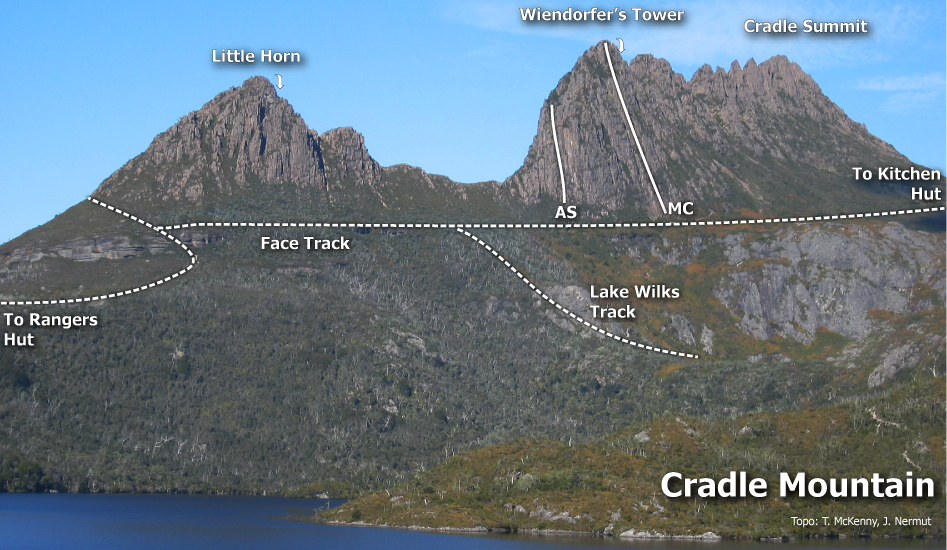
Originally called Ribbed Mountain, with its serrated skyline of gendarmes and gullies, Cradle Mountain's profile has attracted mountaineers and rock climbers since the first ascent of the mountain back in 1828. This was the scene of what is probably the first recorded rock climb in Australia, when two visiting Austrian Mountain Guides traversed the complete mountain cirque in 1914, starting with Mt. Campbell and Hansons Peak, and making the first recorded ascents of Little Horn and Weindorfer's Tower and most of the main ridge. It must have been a massive day, carrying their hemp ropes, long alpenstocks and climbing in nailed boots.
One of the best mountaineering routes in Tasmania. The main ridge is long, very exposed to the weather and takes a full day in good conditions. Route finding is complicated, down climbing technically challenging and exposed (you may want to rig additional abseils for safety) and abseil points may take some finding - take a knife to remove old dodgy tat, and extra replacement slings.
The quickest access is from the car park via the east (L) track round Dove Lake to the Lake Wilks Track which climbs steeply up to join the Face Track. Follow that back east for a couple of hundred metres or so till a definite pad takes off uphill, just before the main track descends steeply, about one and a half hours walk to the east end of Little Horn.
Climb up to the summit of Little Horn, passing the photogenic Smithies Pinnacle, and then follow the main ridge west all the way to the Cradle Mountain summit. The way down from Little Horn to the col can be scrambled although some will abseil it (there was a serious abseil accident here back in the late '70s). Another abseil is down into the top of Dorfers Gully from Weindorfer's Tower (23m), and there is a third abseil a few towers further on (<15m). At times there are small pads to follow but there are many pillars to climb and descend if you want: the choice of routes is yours, depending on how long you want to take or how hard you want to make it. Descend down the main tourist track.
Franz and Julius Malcher, 1914.
On the east end of Weindorfer's Tower, to the R of the main col separating the Tower from Little Horn, is an impressive and reasonably obvious corner, with a very clear white splodge of lichen on the rock, high up. Access the corner from the Face Track which can be joined either via Hansons Peak track or more directly via the Lakeside Track/Lake Wilks Track.
On the east end of Weindorfer's Tower, to the right of the main col separating the Tower from Little Horn, is an impressive and reasonably obvious corner, with a very clear white splodge of lichen on the rock, high up. Start directly below the splodge. 1. Scramble up to the bottom of the right facing groove. 2. Bridge and layback the groove, past a small roof. 3. Scramble off and to the left to join the main ridge. Descend back down the ridge to the col.
N.B. There has been a massive rock fall in this area (2015) and the climb is virtually certainly affected, if not gone!
Nic Deka and Steve Brown, 1978
The early pioneers climbing in the 1920s and 30s clambered all over the main ribs and gullies. One more continuous line was put up on the main face of Weindorfer's Tower in the 1970s but many others have been unrecorded.
Starting on a slab at the left toe of the buttress, the line wends it's way up to finish on the summit. A great choose-your-own-adventure route. For added quality, can "descend" by finishing the Skyline traverse towards Cradle's Summit.
Climbers Union of Northern Tasmania 1977.
Fury Gully Face
Some of the most continuous rock is found on the Fury Gully Face, on the western flanks of the mountain, above the Fury Gorge. From Kitchen Hut, (about 2 hours from Ronney Creek car park), continue south along the Overland Track for a bit over a kilometre to the small creek at the head of the Fury Gorge (to your R). Scrub bash up from here (L) to the base of the cliff and find a pillar that protrudes at its top to form a prow.Only two routes have been recorded here to date, but there is obviously room for more. Descend down Fury Gully to the south or by the main tourist track.
Neale Smith and Bob McMahon (alt.), 14 Nov 1982.
Bob McMahon and Neale Smith (alt.), 14 Nov 1982.
Marions Lookout
From the Dove Lake Carpark, follow the Lakeside track along the western shore, past the boat shed and turn R up the Marions Lookout track. There are several small quartzite buttresses below the summit but only one recorded climb to date.
So named after the artifact found at the start! Plastic Raincoat takes the longest line on the large quartzite cliff below and to the north of Marion’s Lookout. Walk in from the Marion’s Lookout track, cutting left where the track steepens, and contouring round through the scrub to the base of the crag. The climb starts right at the lowest point and takes a line straight up, finishing just to the right of the top. One pitch and the crux was near the top mainly due to loose rock and dubious protection, certainly not the difficulty of the moves.
Steve Brown and Bevis (Fred) Dutton 1976.
Below Marions, on the north side, are some obvious slabs, again of quartzite. These were christened by the late John Woods as the "Saruman Slabs" after the character in Lord of the Rings. At various times, the Climbers Union of Northern Tas members free climbed over the whole area without recording any particular routes. From the Dove Lake carpark, follow the Lakeside track on the west side but turn off to Lake Lilla after 300m.Continue past the lake and then climb up to Wombat Pool. The track above the Pool joins the main Overland Track at the col: scrub bash L (east) across to the slabs. Descent by traversing back west to the main track.
Crater Lake
Viewed from the old boat shed at the lake’s edge, there is a very prominent buttress directly opposite, a pillar of ancient white quartzite. A fine mountaineering route of classic proportions, first climbed close on 50 years ago.

Crater Lake
Access the base by descending the gully to the right (north), from the Overland Track.
“The hard part was getting to the base of the cliff and getting started. We took the right side to avoid the overhangs and from half height it laid back a bit, made for easier climbing but the exposure was something else, I still remember it. It probably took us around half a day to get up. We wore walking boots and used a layered rope called Silver (still used by sailors as it floats) and steel crabs and pitons.” - Bevis Dutton
The angle eases to a scramble at the top: “higher up the quartzite was flaky due to frost shattering and this certainly added to the sense of exposure as protection was iffy.” - Steve Brown
Descend via the Marion Lookout Track.
Bevis (Fred) Dutton, Steve Brown, 1970
Winter Climbing
In a good winter i.e. one where there is snow and freezing conditions, an increasing rarity today, the mountain can offer exciting winter climbing. Since the first winter ascent in 1924, most of the gullies and ridges have been climbed and the main gullies skied down. Snow holes in the massive drifts that can form on the flanks above Kitchen Hut and below Smithies Peak have been the traditional base for climbing, and the most popular gully is Dorfers, leading up to Weindorfer's Tower when conditions are good. The Skyline Traverse can be a major undertaking, taking a full day.
Terror Australis
The route takes a line up the southwest corner of the mountain, up Fury Gully. The route is easily seen when snow covers the mountain as this distinguishes the series of steep gullies/ramps that lead from the start of the route to the summit. A great route, 7 pitches, approx. NZ grade 4 Prior ice experience is recommended. This route is a popular scramble in summer and in winter can become a quality “mountaineering” day in Tassie. The best way to access the route is to follow the overland track to Kitchen Hut then continue around towards the creek crossing at Fury Gorge. You can either head straight up from the creek or in times when the snow is deep you can traverse across to the base of the route from the high part of the track half way between Kitchen hut and Fury Gorge. The route is quite obvious from the gorge and is a gradually left trending gully which has a 5m rock step at its base. During winter this usually has enough snow/ice on it to place a screw for protection prior to gaining the gully proper where occasional snow stake placements will be sufficient for the1st pitch. The 2nd pitch heads into the narrowing of the gully and steepens up enough to possibly require some more regular protection. Pitch 3 will go close to reaching the top of the initial gully and again has a number of steeper bulges of ice to negotiate. The 4th pitch continues up to an obvious shoulder before veering to the right. From here one more pitch will bring you to and obvious chimney/gully which becomes close to vertical. During very heavy snow seasons this chimney pitch can be climbed and requires two axes and some front pointing skill. When there is less snow the bulging slabs on the left provide an alternative and are likely to have good water ice thick enough for ice screws with this route rejoining the top of the chimney at 60m. One more easy pitch takes you up and left onto an open snow slope which can be easily climbed up to the summit. If you have picked the correct line you will be within a few metres of the summit cairn. Descend via the normal route, after a cold snap you may wish to keep your crampons on and an axe handy as there are a number of steep sections where a fall would be unpleasant. Take a couple of snow stakes 4 or 5 screws, a couple of medium size cams and a set of large wires plus 5 or 6 quickdraws and slings. Description by Ian Ferrier, July 2011.
Nic Deka and Nick Williams, Aug 1978.
Barn Bluff
Intro
Barn Bluff (1559m), Tasmania's fourth highest mountain, dominates the views to the west with its bold, square-shaped profile.
Access
Located about 5km south of Cradle Mountain, it is a long days walk from Dove Lake and access is usually as a day walk from Waterfall Valley Hut. Alternatively, camp or bivi close to the climbing but you may need to take water. Continue past Benson Peak at the south end of the Cradle Mountain ridge along the Cradle Cirque and then follow the track along Bluff Cirque for about 1.5km. There has been at least one route done on Barn Bluff. Descend via the normal walking route.
Climb scree on track, then traverse to top of greenery at base of cliff. Double ropes useful. Climb prominent R crack in middle of face (belay on L - slightly protected by overhanging block) until a few m below overhand. Traverse L to next crack. Up this to near overhang, then traverse R at angling ribs on R (Don't touch loose blocks!) Up to top of block, then crack. Top is well below by main summit which can be reached by 'interesting' traverse along ridge.
Dayle Gilliatt, Phil Dolan 6 Feb 1989.
Mt Oakleigh
Intro
Mt Oakleigh (1286m) is a particulalry prominent peak due to the pinnacled ridge leading to the summit which are visible from much of the northern end of the Overland Track. The big ridge of Oakleigh is reputably a classic alpine jaunt and you can make it easier or harder by avoiding some of the gendarmes. Allow a full day from New Pelion hut.
Access
The quickest access to Mt Oakleigh is via the Arm River Track or from Lees Paddocks rather than following the Overland Track. Pelion Hut is a good base. One way is to follow the Arm River Track north from the hut for 400m and cross over the Douglas Creek. Head across the wet button grass plain and contour round under the cliffs in the forest to the toe of the ridge. Alternatively, follow the old Wolfram Mines Track north from the Old Pelion Hut for about a kilometre, and then cut up to the ridge line. Descend via the main walking track back east then south.
This description is based on "An Ascent of Oakleigh Pinnacle Ridge" by Mike Douglas, CCT Circular 1977. 1. Initial steep 150m buttress done in 8 pitches, a little to the north of the direct line. 2. A short abseil leads to the base of the second obstacle, a 50m pinnacle much the same size as the Buttress Pinnacle on he Organ Pipes. A line of easy cracks and chimneys on the north side lead to an airy summit. The only difficulty was the final move past a very awkward bulging chockstone. 3. Two abseils and a long traverse beneath two minor pinnacles put you on top of the massive tower which is the most prominent feature of the upper section of the ridge. There is an easy route on the back of the tower. 4. Thread your way through uppermost set of pinnacles to the foot of the 40m exit chimney which leads to the summit plateau (the tallest of these pinnacles could probably be climbed via an impressive cleft). The route can be completed in a day with an early start, and easy escape is possible at several places.
Mike Douglas, Chris Viney, Feb 1977 (with bivy). Reg Williams and John Moore ascended part of the ridge previously.
Mount Ossa
Mount Ossa is the highest peak in Tasmania, accessed from The Overland Track. There is a clearly marked track leading up to the summit from Ducane Gap. The rock formations on Ossa are Jurassic dolerite nunatak's, the Dolerite has good friction and reliable protection. The column structures can be loose in places, most of the cracks are covered in lichen/moss requiring care and some cleaning.
With on going COVID restrictions, bookings to walk the arm river track must be made in advance.The approach is a Steep hike 6+ hour hike, access is via the Overland Track from a turn off at Ducane Gap. Approach can be made within 1-2 days hiking in via the Arm River Track to Pelion Hut and continuing up to Ducane Gap. The hike is roughly 20km with over 800m of altitude gain. Booking to Camp in Pelion Hut is advised to minimise the impact of camping on sensitive alpine vegetation. Routes are protected traditionally, the crag at the Gates of Mordor is mostly single pitch climbing in alpine conditions.
Gates of Mordor
Seen clearly from Mount Doris, the Gates are an imposing feature guarding the approach to the summit of Ossa. Crag can be accessed from the main walking track, the highest quality rock is on the southern wall of the gates.
The well protected central crack line with varied classy climbing, the route leads up and behind the imposing pillar. climb the crack direct through a corner into an overhanging crack, layback to ledge without escaping right or left. Climb up chimney with small protection to the top of the pillar, jump or bridge the gap across incut ledge to topout and belay.
Paul Mackrell, Michael Lehmann, 24/01/2021.
A serious climb up the exposed face of the main pillar. Climb the crack system of FOTR to the ledge. An 8mm chord wrap was placed around the pillar for the first ascent to protect the delicate traverse and mantle on the face. From the ledge traverse to an insecure shallow corner on the arete, climb delicately to a mantle on slopey ledge. A horn can be slung on the right side of the pillar to protect the top. Follow a strenuous sequence(Crux) to the top of the pillar. Jump from pillar to ledge scrample to topout/belay.
Michael Lehmann, 25/01/2021, 8mm chord was thrown over lower pillar from FOTR, rope was tied and used as pro on lead.
Cathedral Mountain
Intro
Cathedral Mt presents a tantalising wall of rock as you walk along the Overland Track south from Kia Ora Hut. The geology of the cliffs, however, very much dictates the climbing here. Most of the cliff is undercut - the base is actually the bottom of the dolerite and has very few cracks - and to climb across the blank-looking roofs anywhere to get onto the main cliff would be very, very hard - no easy routes here! The only recorded route to date used the easiest and probably only spot you can readily get onto the main cliff and that was via a huge flake that had fallen off, and this provided a bridge onto the main cliff thus avoiding climbing the desperate looking undercut. The cliff above the flake also looked like it had enough cracks to be only of moderate grade and that was significant as well as some sections were fairly blank looking. Subsequent would-be climbers have so far been repulsed by the overhangs and lack of protection in the fused cracks.
Access
Access isn't simple. John Chapman started from the end of the Mersey Road near Moses Creek and "there was then no track so we climbed through forest to Chapter Lake then westwards onto Cathedral Mountain - roughly the route of the current day tracks except we went around the south side of Chalice Lake". Alternatively, follow the Overland Track north and cross the Mersey River if you can by the chockstone below Fergusson Falls .
"The climb is fairly easy to find. About a quarter of the way (very rough estimate) along the base from the northern end is the huge flake and this is near the base of the arête between the north facing and north-western facing cliffs (I think its just south of the arête proper) - its not hard to find as its the only one! We climbed directly up from there in a straight line and the cracks were initially thin with lots of bridging etc then as we got higher the crack widened into a chimney. As time was getting on, we did the top third solo but that was under grade 10. The flake and lower part of the cliff we graded as 16. My notes show that we basically followed the arête between the north-western facing side and the western facing side and the climb probably tops out at close to the 1387 spot height that appears on the Cathedral Map (Tasmap 1:25 000 Cathedral and Du Cane)".
John Chapman and Joe Friend, January 6th 1975.
Summit Routes:
These routes were accessed from the top of Cathedral peak, walking in past Chalice Lake and Tent Tarn.
Climb the wide crack to a bouldery exit past giant chockstone.
Rosie Hohnen 2004
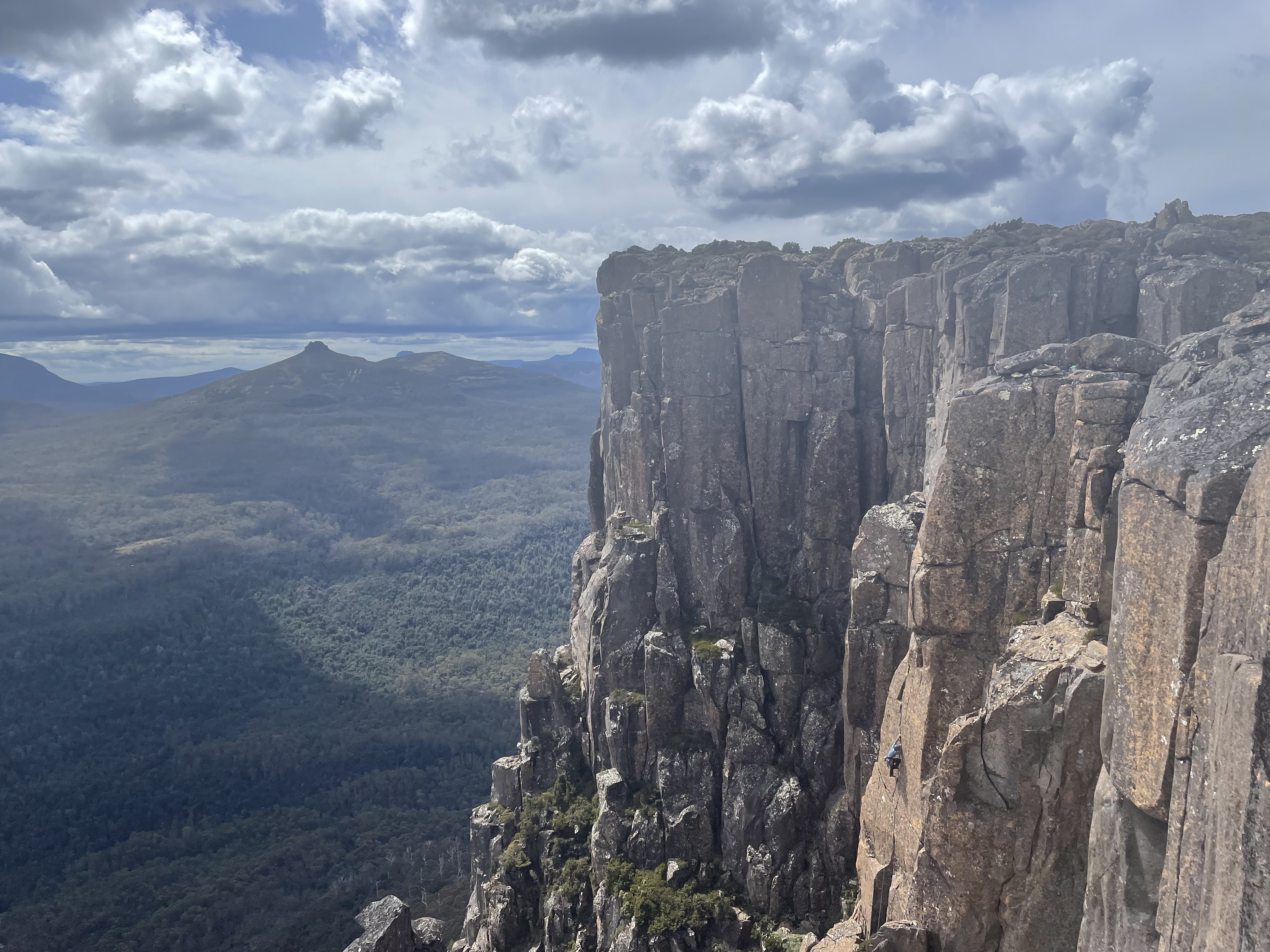
Top of the route is -41.889092, 146.110681. Rap down to bushy ledge. Climb thin stemming corner on small gear and then up the sporty finger crack. From the top of the the finger crack, swing right, mantle and up through the roof crack. Fun route!
Liz Oh and Tyler Rohr Jan 2024
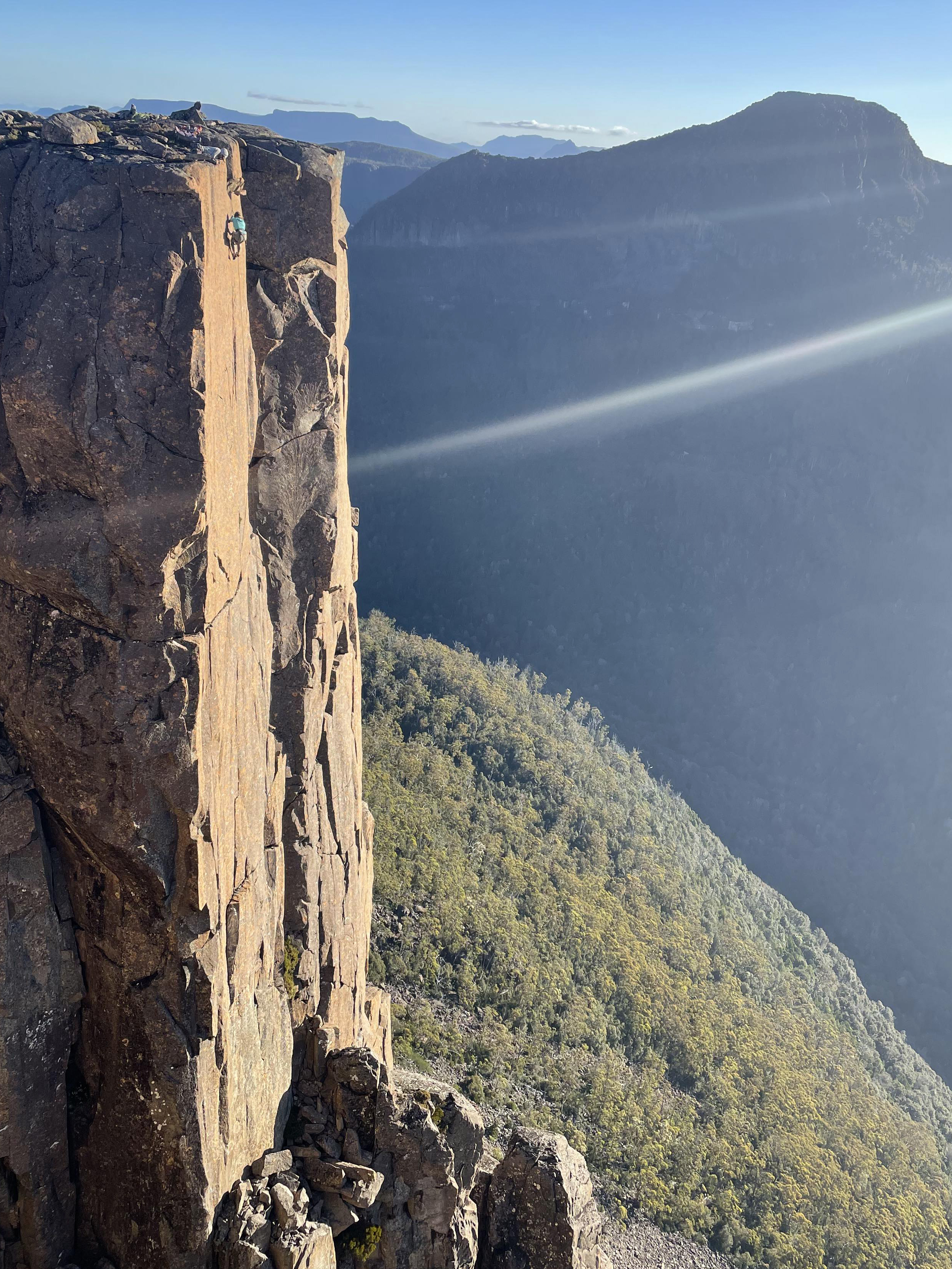
Gnarly thin crack up the middle of the prow, all moves done on top rope but would likely end up around 29/30 R.
Alex Hartshorne 2024
Alex Hartshorne & Rosie Hohnen 2024
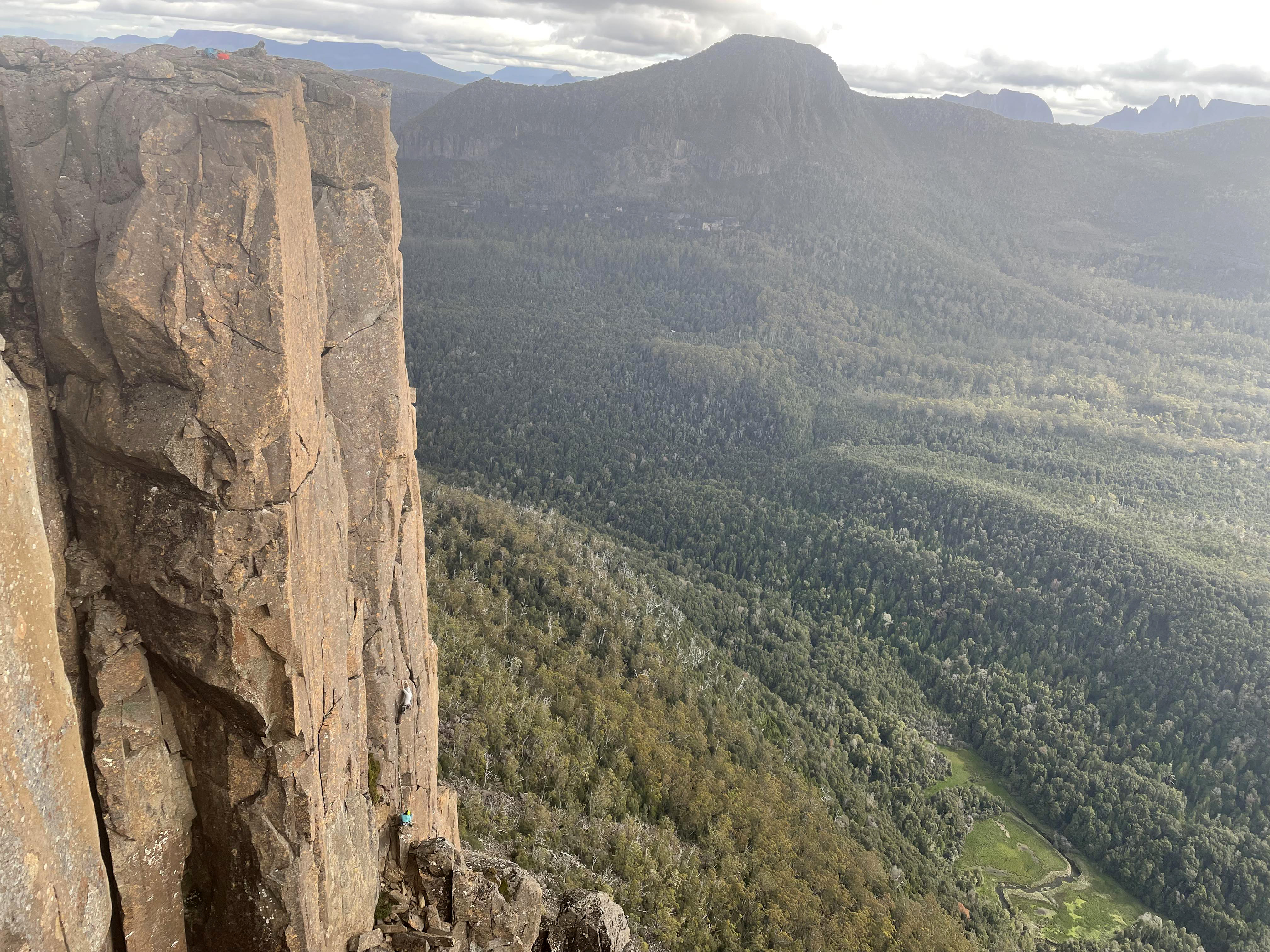
Kim Ladiges, Tyler Rohr, Liz Oh (alt), Jan 2024
Mt Geryon
Intro
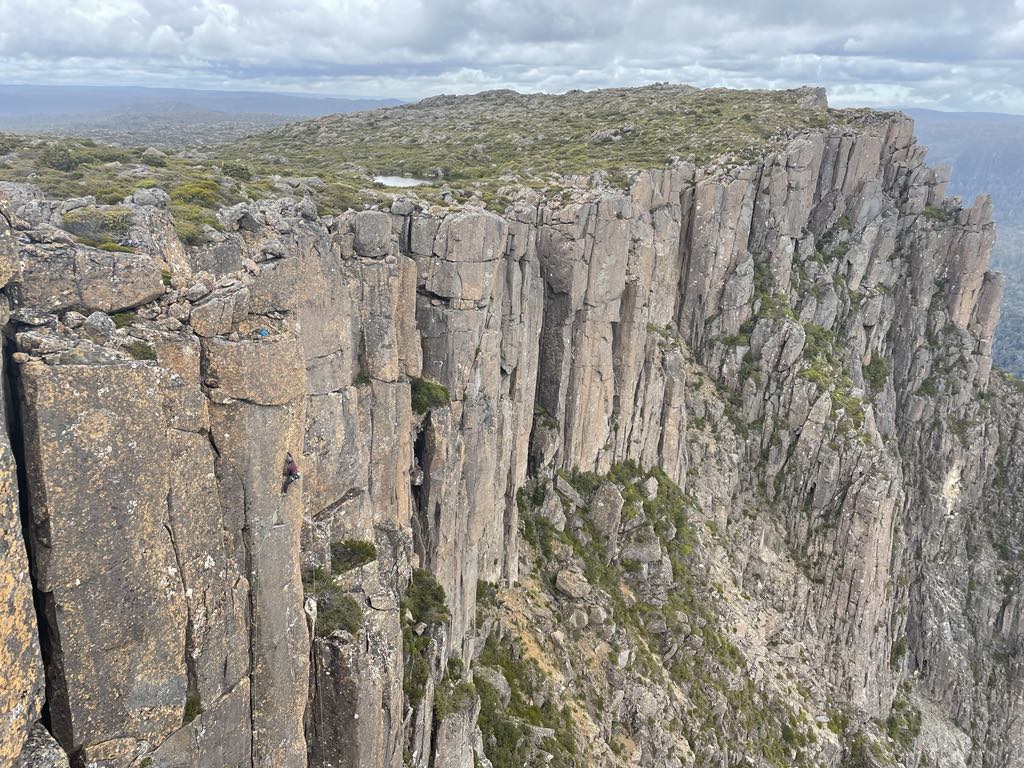
The cliffs of Mt Geryon and The Acropolis provide absolutely exceptional climbing "on the wild side". Many of the routes have had few ascents, so obviously take appropriate precautions - the seriousness of accidents is high, with help a good day's walk away. The downside of the climbing is twofold. Firstly, expect the usual foul weather. Multiple trips before even laying chalk to rock are hardly uncommon (no joke). Secondly, packs full of camping and climbing gear are good "fun". Described below are the classic traverses - and not to be missed! The north to south direction is the norm, but it has been done the other way, both ways in a day, and even in winter. This is a classic day in the mountains, with nothing too serious to stop competent climbers. The crags were written up in the 1984 issue of Australian Rock and a guidebook was later published by Chris Baxter in 1999. Refer to that guide for full details of all climbs. The route descriptions have been reproduced here, however more detail around access etc is needed. If anyone has high resolution photos (4+ megapixels) of these faces suitable for topos please send them in.
History
Climbing the peaks of Geryon was never going to be easy. This is a mountaineer’s mountain, located up a remote, deep-sided valley and accessed by a long bush walk or, if you were lucky, by travelling some of the way by boat. The three-bodied giant of Greek Mythology has no “easy way round the back” and the first recorded ascent wasn’t until 1937 when Hugh Gordon and David W Wilson from the Hobart Walking Club pioneered a route up the Northern Peak, the highest on the range (1516m). The mountain was not climbed again till 1948 when Bill Bewsher, G. and R. Sharman and R. Lewis repeated the Northern Peak climb but the following decade or two saw a period of exploration mountaineering matched only by that on Federation Peak.
In March, 1950, the Launceston Walking Club stepped into the picture when John Daniel and Keith Lancaster accompanied David Wilson back to the Northern Peak on a preliminary reconnaissance trip. They returned in November 1950 with Jim Turner and Chris Binks and this time they summitted on the Southern Peak (1509m), with Lancaster and Daniels going on to climb the Southern Spur. The following year, 1951, they were back for a successful “do or die” attempt on the Foresight, with all four reaching the summit.
Over the next couple of years Sydney Rock Climbing Club and the Melbourne University Mountaineering Club members visited, with Nada Cox, Marie Dickenson and Nicki Dankin making the first female ascents of Geryon summits in 1959, followed soon after by with Beth Wilkins who, along with Peter Johnstone and John Fairhall from the Van Diemen’s Climbing Club and the HWC, made the first ascent of the Southern Spur.
It wasn’t long before climbers were back to attempt the first winter ascent. A Victorian Climbing Club party in 1959, launched “Pinefreeze 1” where they established a camp at the col between Geryon and the Acropolis but an accident and consequent rescue operation curtailed their attempts. Nevertheless, Bob Jones and Geoff Cox did manage to reach the summit of the Spur.
In August the next year on “Pinefreeze 2”, George Glover, Geoff Shaw, Bruce Naylor and Lloyd Lobbe, Peter Davis and Charles Roxborough climbed the Southern Peak, and about 10 days later Ron Cox and Pat Conaghan from the University of Queensland summitted on the Northern Peak. Apparently they had never climbed snow before and their only knowledge came from text-books. Descending the mountain after their successful ascent, Cox slipped and fell 50m with Conaghan arresting him on an ice axe belay so preventing a disastrous fall 350m down the west face.
In Jan 1961, the same pair was back for another epic, this time the first traverse North to South of the Mountain, involving 3 bivvies with little food or water, a serious and impressive mountaineering feat involving technical climbing and the use of aid on the harder sections.
The problem of getting to the crags for the pioneers in the 60s was cunningly circumnavigated by the purchase of a boat, the good ship "Venus", for the newly formed Climbers Club of Tasmania. The early history is full of stories that focus as much on the trials and tribulations of the weekend sailors as it does on their actual climbs. Nevertheless, significant new climbs were added, particularly on Geryon and the Acropolis, by the likes of Tom Terry, Alan Cross, Reg Williams, Allan Keller, Phil Robinson, Bob Jones and Bernie Lyons, resulting in some of the longest and most spectacular climbs in Tasmania. The Victorians were here again, in the late 1960s and early 1970s, with a youthful Chris Baxter, John Moore, Phil Stranger, Roland Pauligk, Glenn Tempest, Chris Dewhirst and the Gledhill brothers. New climbs continued to be discovered, if at a less hectic pace, with locals Col Hocking and Chris Rathbone joining the push, but in more recent times there have been few major additions other than the Shield, a 450m 24 on the East Face of Geryon by Steve Monks and Jane Wilkinson.
Access
The Geryon Campsite (970m) is in the bottom of Pine Valley giving access to a long scree slope (now encroached in places by fagus) heading up to the South Peak of Geryon and climbs on the west face. This also gives access through the Geryon-Acropolis saddle to the north face of the Acropolis and the bivouac cave Heim at the foot of the east face of Geryon. Heim can also be reached from the Pine Valley Hut by climbing the Acropolis (1481m) and descending steeply to the S. Spur-Acropolis saddle. See 'The Acropolis' section. For the Mt Geryon North-to-South Traverse, the best camping is in the Labyrinth, straight up from Geryon campsite at the Pool of Memories (1130m). Alternatively, and easier for those without bush experience, the Pool is reached by taking the well-used Labyrinth track above Pine Valley Hut.
Geryon Campsite
From Pine Valley Hut (830m) start as for the Acropolis summit track. Follow this for ~ 20mins and cross a long log bridge over Cephissus creek. Leave the Acropolis track which continues up the hill away from the creek. Head up the valley following the eastern side of creek occasionally coming across the odd tape marker. These are generally orange at the time of writing, 2022, with occasionally a blue one. The old red and white paint markers on trees are very rare. There is virtually no track nowadays though the bush is fairly open. Follow the creek looking for the odd tape marker, at times directly beside the creek, though the going is often easier away from it, sometimes skirting around uphill from the creek a fair way Closer to the campsite you should pick up a track next to the creek with occasional tape markers. The camp is a flat open area and has an old wood sign saying ‘Geryon Campsite’.
Pool of Memories,
Walk to the Geryon campsite, cross the stream here to the west and climb through the bush for a few minutes to a scree slope. At the top of the scree slope ~15-20min. from camp, continue straight up for a further 20-30 min. into the Labyrinth. A cairned route to the right takes one to the Pool of Memories. Alternatively, from the Pine Valley Hut take the Labyrinth track past Lake Elysia.
Access to scree slope leading to Mt Geryon
About 30m south of the campsite there was a blue taped route up the through the bush to the foot of the scree slope taking 10-15 min. Now (2022) there are virtually no markers so probably best just to head up regardless, you may see the odd tape on the way. Once on the scree there are cairns leading up to the South Peak. At the top of the scree head right uphill until one reaches a bivouac cave (not Heim) overlooking the Acropolis saddle. The S. Peak normal route (see route description) takes off above the cave, look for cairns.
Mt Geryon West Face
Geryon South
Geryon Traverse.
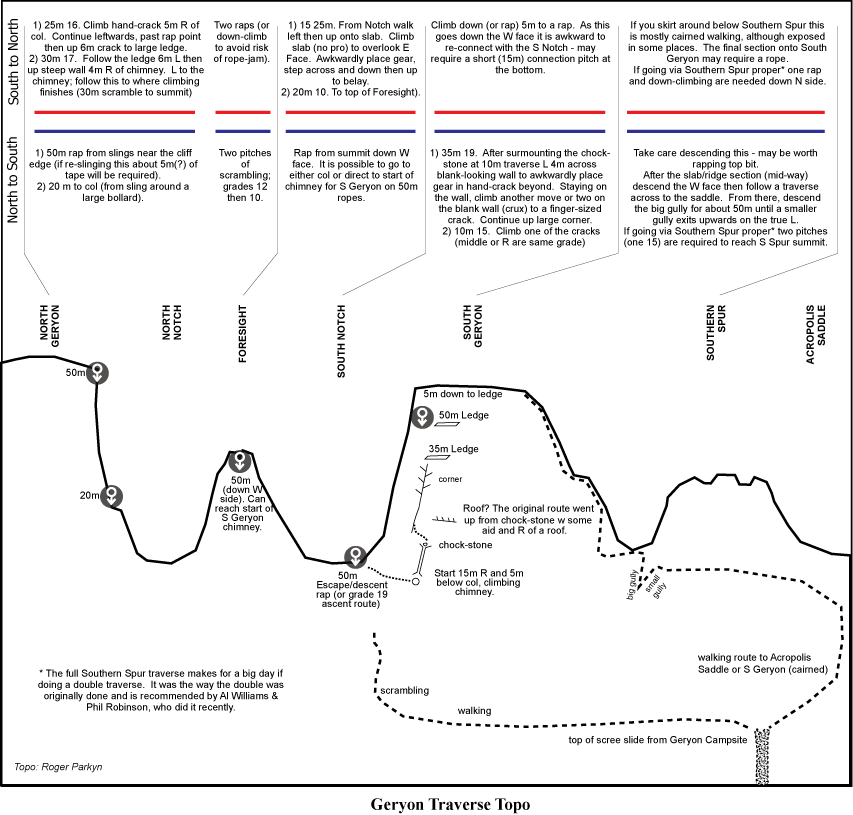
The recommended way to do this is South to North and then reverse North to South in the same day. This makes for more climbing and less walking and is around 10-14 hour day from Geryon Campsite.
North Peak Normal Route
From the Cephissus scree chute traverse N below the cliffs of the South Peak. From near the foot of the Foresight descend a large gully and continue N under the cliffs of the North Peak to a scree gully. From the top of this go S along the level ridge and down to a saddle. Scramble up S to the N summit of the peak.
D.W. Wilson, H. Gordon, 30 Dec 1937. FA winter: R. Cox, P. Conaghan, Aug 1960.
Rob Taylor, Jerry Grandage, Daryl Carr, varied leads, 27 Jan 1968.
Clive Parker, Roger Caffin (alt), 23 Feb 1968. Alan and Geoff Gledhill did the first free ascent of pitch one (originally 12, M3), 22 Jan 1969.
J. Daniel, J. Turner, D. Pinkard, K. Lancaster, C. Binks, 1 Jan 1951.
Head up the square corner from the Foresight-South Peak notch. Above the sloping ledge, follow the crack up the corner past two bulges. Ascend the east face for the last 3m.
P.Schwitter, S.Bunton, G.Jordan, Mar 1988.
Kieran Loughran, John Stone (alt), Jan 1979.
Tom Terry and Alan Cross, 1967.
Starts from the gully leading to the Foresight-South Peak col. 1. Climb the NW face 2. Traverse R to the W face proper 3. Slab and corner 4. Crux - chimney and off-width 5. Easy gully to N end of the South Peak.
Kim Bischoff, Grant Dixon, Phil Robinson, varied leads Christmas 1979.
Chris Dewhirst, Roland Pauligk, John Moore, varied leads, 24 Feb 1967.
C.Baxter, D.Gairns, G.Talbett, Jan 1989.
Tony Crapper, John Bennet, varied leads, Gordon Talbett, 1 Mar 1968.
Bruno Zeller, Tony Crapper, Feb 1968.
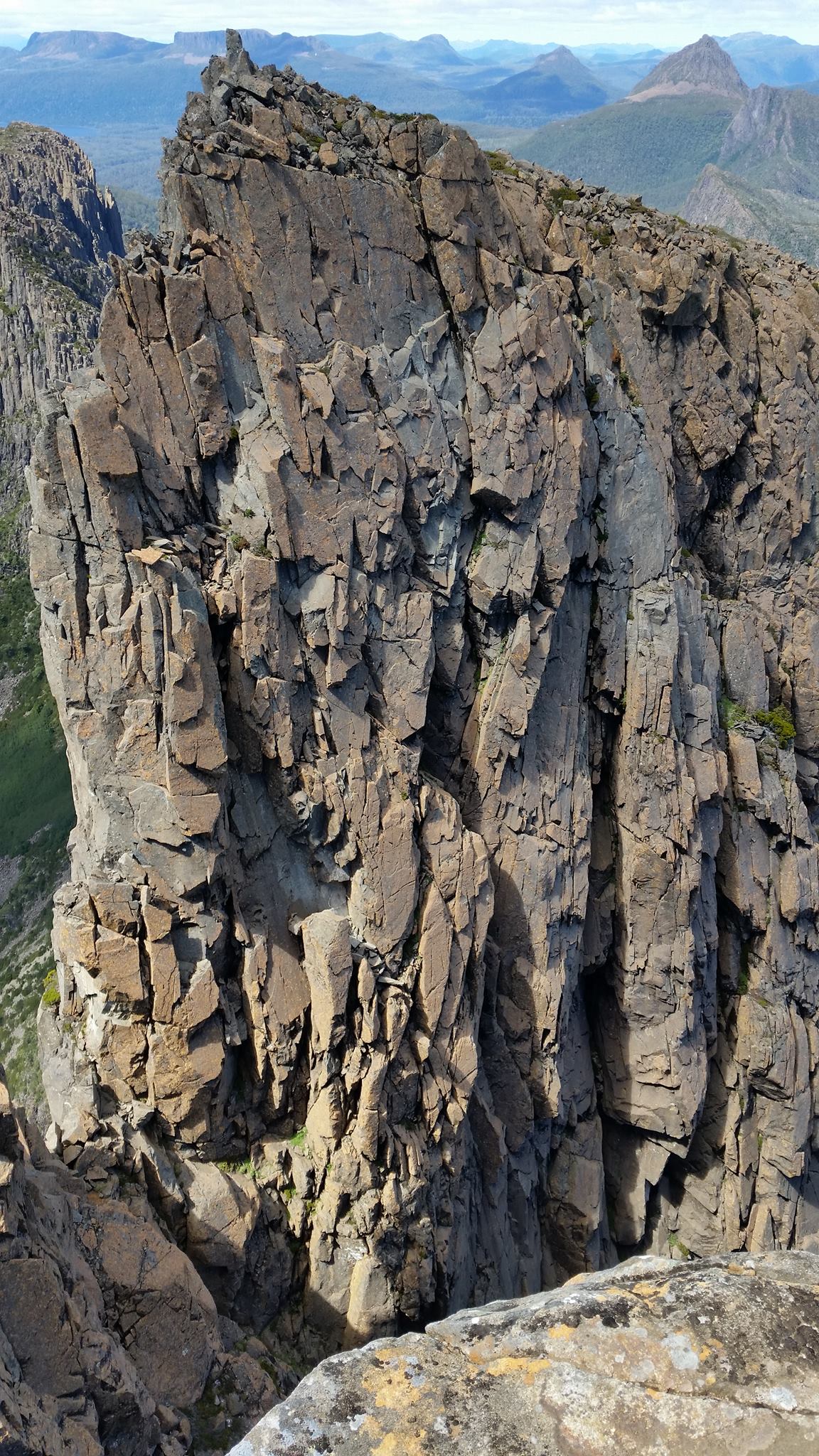
From the head of the scree chute leading down to the Geryon campsite, scramble up right to pick up a route to the bivouac cave above and north of the Acropolis-Geryon saddle. Go directly above the cave and scramble north below the west cliffs of the South Spur. Drop down a steep gully below the northwest arete of the South Spur into another gully which leads to the col between the South Peak and the South Spur. Go up to just below the col, then either traverse easily on the west side below the ridge, until you can scramble up to a large slab, or alternately, follow the skyline ridge (exposed) from the col to a slab. Climb the slab and gullies to the top.
J. Daniel, J. Turner, K. Lancaster, C. Binks, 5 Nov 1950.
Dayle Gilliatt, Phil Dolan 31 Jan 1989.
Enjoyable and straightforward, this route climbs the middle of the N wall of the South Spur. Start in the gully about 50 m below the South Peak-South Spur notch. 1 & 2. Straight up the wall in a series of steps to the NW arête. 3. 15m. Arête.
Chris Rathbone, Phil Robinson varied leads, 25 Feb 1983.
Allan Keller and Terry Costigan, 7 Dec 1967.
From the Acropolis-Geryon saddle follow the skyline ridge moving out over E face (exposed) where necessary. Mostly scrambling.
J. Daniel, K. Lancaster, 5 Nov 1950.
For more information on the following traverses, refer to Roger's topo at the beginning of this section.
J. Moore, R. Williams, 15 Jan 1966.
R. Cox, P. Conaghan, 10 - 12 Jan 1961, with three bivvies. F recorded FA(but likely done before this): A. Landman, I. Groves, 1997.
The two-way traverse of Geryon's four peaks makes for a long and demanding "mountaineering" day and has had few ascents over the years. Starting from the south, the first double traverse was completed by Lyle Closs and Reg Williams on 31 Jan, 1971. The double traverse of all peaks is very rarely done, the 2nd crossing may even have been by Al Williams(Reg's son) with Phil Robinson, saved from impending benightment by Reg coming up the scree slope with a torch!
Mt Geryon East Face
Routes here are best accessed from a bivvy cave known as "Heim" that is directly under the east face. To get there from Pine Valley Hut, follow the track to the Acropolis summit and descend into the Acropolis-Geryon saddle (short downclimb section). Drop off the saddle on the east side and skirt under Geryon East Face to Heim. Heim accommodates 3 people comfortably and it has a water source about 100m further north and down the hill slightly.
John Moore, Chris Dewhirst (alt), 18 Feb 1967.
Allan Keller, Tom Terry, Mike Douglas, 6 Mar 1966. FFA Jerry Grandage 23 Jan 1968.
Roland Pauligk, Peter Canning, varied leads, 18 Feb 1970. First free ascent (three aids from pitch 7) Peter Treby, Terry Brookes, varied leads, Jan 1974.
Roland Pauligk, Rob Taylor (alt), Jan 1968. FFA Ross & Lachlan Taylor, February 2012.
In the third small 'bay' down and round R of the previous climbs an obvious easy scrubby line slants up L behind a huge flake. From the R end of the scrubby ledge atop this, some 25 m up, go up short scrubby walls and move up and across R, mainly on easy vegetation to the foot of an enormous gully leading up L to the North Peak-Foresight col. (From here Jones and Lyons apparently more of less followed the last two pitches of the normal Foresight route.) (In Mar 1983 Glenn Tempest, solo, did a significant variant, grade 16, up the buttress immediately L of the huge gully.)
Bob Jones, Bernie Lyons, leads unknown, 26 Dec 1961.
Steve Monks, Jane Wilkinson 20 Feb 1994
Alan and Geoff Gledhill, varied leads, 28 Jan 1969. On the second ascent in 1974, Keith Wadsworth and Rein Kamar, alternate leads, eliminated single aids from pitches 6, 9 and 12. Ian Brown and Keith Williams eliminated the final aid sling from pitch 9 in 2000 (at grade 16 or 17).
John Moore Roland Pauligk, alternate leads, 28 Feb 1967 to 1 Mar 1967
East Face of Du Cane Plateau (Point 1507)
In Rock No 59, (Winter 2004), there is a description of a climb made on the plateau edge to the north of the Geryon North peak.
Aaron Kristiansen, Simon Wedsel, 25 Feb 2004.
The Acropolis
Intro
The columnar architecture of the Acropolis is alluring and yet far from forgiving. Routes here are steep and sustained demanding energy bursts from the climber far past the point where body and mind are flagging. Climbing on the Acropolis brings a new definition to the term "feeling totally shagged," and yet the climbing is rewarding and tantalising in spite of the effort required.
Access
Access From the Bottom: Routes can be accessed from the Heim bivvy cave directly under the east face of Geryon, or directly from the Acropolis-Geryon saddle. Access to and from Heim is described below. In a long day, routes can be climbed from either Geryon campsite or Pine Valley hut, each via the Acropolis-Geryon saddle. For this route, drop off the south end of the saddle, avoiding cliff bands by following a series of vegetated leads. Once at the base of the cliff, skirt close to it up and left through low vegetation. Allow 30 minutes from the saddle to the base of the routes.
Access from Top: From the top of the Acropolis walk over towards Geryon (if you can see it), following a vague, but defined track until you sense you are above some decent cliffs. To identify the top pitches of established routes your best bet is to look for fixed gear over the edge, (e.g. the antique wooden wedges at the top of OWH/TGOE, or the bolted arete of TFS). Astroboy is also prominent, as is its blocky starting ledge. Four 50 m abseils can be made roughly following the line of Black Man's Country, primarily off sling anchors. Slings are not in-situ.
Access to Heim
From Pine Valley Hut, follow the track to the Acropolis summit and descend into the Acropolis-Geryon saddle (short downclimb sections). The best route is found by continuing to the end of the North Face and staying close to the ridge until 50 vertical meters above the saddle. From here, a route weaves between the ridge and a prominent gully off left, following the line of least resistance. Allow 1 hour to descend if finding the route. Continue to the north end of the saddle. With increasing popularity, a proliferation of poor pads and trampled vegetation have developed from here. The least vegetated option is described here and it would be best to stick to this as closely as possible.
Follow an intermittent pad down and left from the north end of Acropolis-Geryon saddle for 30 m. This joins a lead short lead of open scree. Follow this down and into another intermittent pad trending down and left. Where the pad meets the base of a shallow angle buttress traverse across this true left to meet a long open section of scree. Continue down and left across this scree as it becomes increasingly vegetated (do not follow pads across vegetated terraces) to the toe of the lowest rock band. This is directly beneath the South Peak of Geryon. This part of the route can mostly be seen and planned shortly after dropping off the saddle. Contour across from here, hugging the toe of rock band through beech, and then continuing 40 m further through mixed scrub on intermittent pad to meet a deep, 5 m wide drainage gully. Go up the drainage gully for 50 m (20 vertical m) to a short rock band 20 m from the cliff base. Exit R here on a faint pad (good footing) and continue up and right into increasingly lightly vegetated screes. A further 15 minutes of skirting close (within 20m) to the East Face bring you to Heim. 45 minutes from the saddle in total with most of the distance on open scree.
To reach the water source from Heim, continue a further 100 m along the cliff base past a fan of scree and then 30 meters down hill.
From Heim to N Face
To reach routes on Acropolis North Face, sidle back towards saddle as for access to Heim, described above, for 20 minutes. Once at the toe of the lowest rock band on Geryon E-face (directly beneath Geryon's South Peak) these routes diverge. From here, contour 100 m south across lightly vegetated screes and locate a narrow scree which takes a fall line down the face for 150 m. (This is 100 m before a very large stand of fagus is reached.) Follow the lead of scree straight down for 100 m and then down and right across mostly open screes, staying beneath the stand of fagus. This eventually joins a broad scree filled gully/depression. Follow the gully up, heading directly to Acropolis N Face, passing through short stands of beech and scrub into the largest scree field beneath Acropolis North Face. Continue to top of the scree field. Access to base of the climbing routes from here is a further scramble up and left trough low scrub. Allow 1 hour in total to approach.
The Acropolis North Face
Chris Baxter, Dave Moss (alt), 3 Mar 1983.
Start at the foot of the lowest buttress on the face (down R of Venus, on the next buttress - really the middle one). Broken climbing for 60 m up the crest of the buttress leads to a large green gully running diagonally down L. Cross this and continue up, moving slightly L for 75 m to a prominent chimney. (A traverse off L is possible here.) Climb the chimney and go up to a short wall. The final pitch (36 m) is the crux; go L round the corner and climb a crack to a large ledge. Traverse R above the belay and go up the steep line. Finish up chimney between face and pinnacle.
John Worrall, Reg Williams, (alt), 19 Jan 1966.
Chris Baxter, Dave Moss, (alt), and Miles Martin, 6 Mar 1983.
This remarkable and sustained crack is approached by abseil from the top of the cliff. Take many #1 Camalots / #2.5 Friends. The first L-lacing corner L of the top of Fury; starting from a block ledge.
Glenn Tempest, Russell Clune, 7 Mar 1983.
The sharp arête R of Astroboy. Abseil to the Astroboy start ledge (a 50m rope doubled just makes it). Stupidly exposed barn-door laybacking on perfect rock.
Nick Hancock, Roger Parkyn, Mar 2004.
J.Keane, D.Baker, Feb 1991.
Peter Treby, Terry Brookers, varied leads, 31 Jan 1974.
John Fischer and Simon Bischoff, 25 Feb 2012.
Dayle Gilliatt, Phil Dolan, 29 Jan 1989.
Glenn Tempest, Russ Clune (alt), 6 Mar 1983 (Originally done with one aid at the top; both led that pitch free next day).
Ben Maddison/ Ingrid Crossland April 2015
Glenn Tempest, Chris Baxter Mar 1983.
Glenn Tempest, Russell Clune, (alt), 3 Mar 1983.
Chris Dewhirst, John Moore, varied leads 17 Feb 1967. Glenn Tempest and Russell Clune eliminated the two aids from the final pitch on 7 Mar 1983.
A six-pitch route starting up the wall 7 m R of TGOE and following a direct line. The last pitch is the crux.
Chris Rathbone, Phil Robinson, (alt), 24 Feb 1983.
A testing wide single pitch. Now (Mostly lichen free) Abseil into the dihedral to the right of finishing pitch of BMC to a craped belay off small ledge with tree. Up widening crack. Doubles from #0.5-3 single #4 and #5 and medium nut.
Samson Stensleton and Fraser L-R
The Acropolis West Face
Follow walking track towards summit of the Acropolis as far as the foot of the bluffs on the S face. Head L, following foot of cliff for about 300m to detached, sky-scraper-sized tower (two hours from Pine Valley Hut).
John Moore, Reg Williams, Chris Dewhirst, varied leads, 19 Feb 1967. (Description amended by A. Kristiansen, Feb. 2004. For more details see Rock No 59).
Col Hocking, Phil Robinson, varied leads, 31 Jan 1977.
Acropolis Pillars
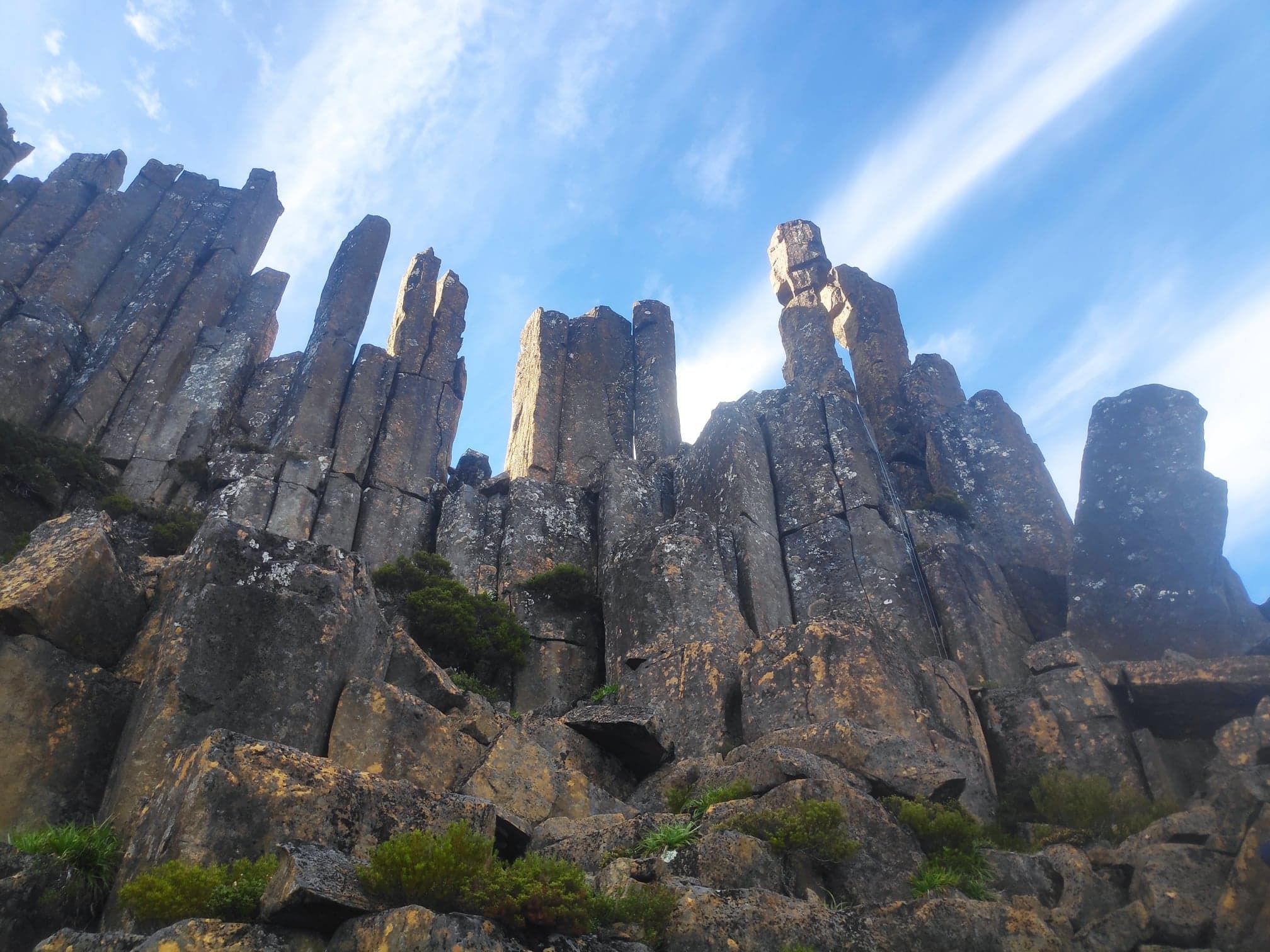
Taking walk track to acropolis summit, 100m below summit traverse to the right on faint pad leading to East Acropolis summit. Along this path you will reach the Pillars of the Acropolis. Many of the pillars appear to offer easy though somewhat unprotectable climbing, descent by counterbalance rappel will be necessary as tat in this area, next to hikers track would be unsightly.
Gentle Hand crack in open book corner, belay off blocks above.
Samson Stensletton and Fraser L-R
Pure tips crack. Awaiting return for an FA.
The fat friend pillar can be ascend by 4 separate cracks.
Either the the steep thin crack in the SW corner at grade 19.
Or the slabbier hand crack and grade 17.
Counter balance rappel.
Fraser L-R and Samson Stensletton
The Guardians
Author
Compiled by Tony McKenny from information in Argus and CCT Journals with additional information and help from Chris Baxter, Peter Jackson, Steve Bunton, Bill Andrews, Kevin Lindorff, Stefan Karpiniec, Jon Nermut, Bob Bull, Ross Taylor and Kate Hamilton
Intro
Despite the fact that these crags are clearly visible from Lake St Clair, climbers have long passed the Guardians by in favour of the delights of nearby Geryon. The cliffs form an impressive escarpment, about 1.5km long, of off-vertical buttresses and walls ranging along the south end of the Guardian Massif (1394m). The rock is dolerite but unusual in that, although there are some chimneys and crack lines, columnar jointing is not obvious and the structure is in part determined by a set of strong joint planes dipping south and presenting a series of steeply sloping ledges and slabs. Appearances from below though are deceptive and the rock is generally steep, offering delightful climbing of a high standard.
Access
The quickest access is by boat (http://www.lakestclairwildernessholidays.com.au/lake-cruise-and-ferry or contact (03) 6289 1137) from Cynthia Bay up Lake St Clair to Narcissus Hut. Follow the Overland Track west for 200m until the signposted turn-off is reached for Lake Marion and Gould Plateau. The track leads off north across the flat boggy plain for about 2km to Nicholls Junction. Take the LH track along Marion Creek to southern end of Lake Marion where the track ends (GR 203512), about another 5km or 1½ hours. From a campsite by the lake, walk and paddle round the western side of the Lake, then head more or less directly up towards a large scree falling to the R of the prominent summit buttress (one group advocated actually wading across the lake as being quicker and easier...). The going is complicated by a belt of “jungle” between the lake and the cliff and progress is slow – allow up to 1½ hours to the base of the rock. Alternatively, climbers have continued up to the summit via the east face of Mt Gould or from Pine Valley Hut, and camped at the idyllic tarn near the Guardian's summit, descending to climb on the face. The descent gullies were originally marked with cairns back in 1974, probably long gone, but an abseil bolt (which may still be there) was placed at the head of the main gully as well. As with all the WHA, a Parks Pass is required by all climbers visiting to the area. Please stick to the principals of minimum impact bushwalking and climbing (no bolting for example). This also a “stove-only area”. For further information see Tasmap 1:25 000, Du Cane 4235 and Olympus 4234, or Cradle Mountain – Lake St Clair 1: 100 000.
History
To say these crags have been neglected is an understatement. In fact there appears to be only three recorded visits by climbers. In 1972 a large party from the CCT including Ian Lewis, John Moore, Reg Williams and Bob Bull made a reccy, working out the access and prospecting for new lines resulting in two routes of significance, Theseus (15) and Sunfighter (14). A couple of years later, Peter Treby and Terry Brooks visited and climbed Grenadier (14) and Guardian Angel (14) while Roland Pauligk and Reg Marron climbed a number of serious lines on the same trip including epics such as The Dragon (20), 280m and the equally big Monster (20), major efforts on this remote crag. The trip was made even more exciting when Anne Pauligk and her climbing partner were nearly benighted resulting in an epic rescue by the others in driving rain and darkness. The Victorians were back in 1976 when Kevin Lindorff and Roark Muhlen added Excelsior (15), and the weirdly named Arch De Ballsnatcher (16). Since then… apparently nothing.
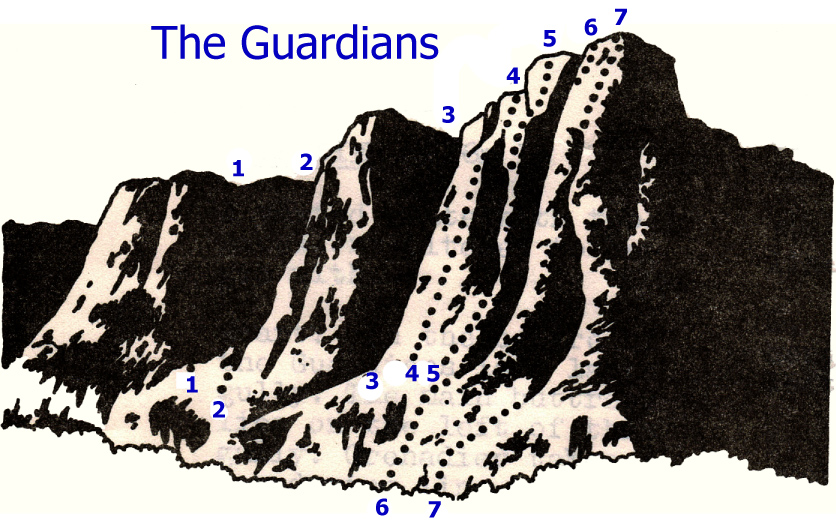
The most obvious landmark of the cliff is the towering summit buttress, with a series of lesser buttresses to the left, and a line of walls and smaller buttresses continuing round further right.The climbs are described from L to R (that is, from approximately west to east).
Ann and Roland Pauligk, and Reg Marron, 29 Jan 1974
Roland Pauligk and Reg Marron, 25 Jan 1974.
Ann and Roland Pauligk, and Reg Marron, 29 Jan 1974.
Roark Muhlen, Kevin Lindorff (alt), 15 Jan 1976.
Terry Brooks and Peter Treby, 24 Jan 1974.
Roland Pauligk and Reg Marron, 28 Jan 1974.
Roland Pauligk and Reg Marron, 24 Jan 1974.
Roland Pauligk and Reg Marron, 26 Jan 1974.
Ian Lewis and Reg Williams, (alt. leads) 5 Mar 1972.
Peter Treby and Terry Brooks, 25 Jan 1974.
The poor man's Monster? Starts at the head of the first gully L of the descent gully at the RH end of the cliff. The leaning right-angled corner on the L provides a good first pitch which leads to a ramble to the top. 1. 40m. Up the corner (crux) and continue up the line to belay. 2-4. 140m. Move up and slightly R to gain the rib (R of gully) then follow this up and continue to top.
Kevin Lindorff, Roark Muhlen (alt), 13 Jan 1976.
John Moore and Bob Bull (alt. leads), 5 Mar 1972.
Mt Ida
Intro
Mt Ida, on the east side of Lake St Clair, is one of the easiest mountains to recognise due to its conical shape with a sharp dolerite point. The mountain was the scene of a number of epic attempts, summer and winter, via the good ship Venus in the 60s and 70s, but is rarely climbed today.
Access
Access to Mt Ida, on the eastern shore of Lake St Clair, was originally by boat but future climbers may have to foot slog in due to a proposed change in Park's access policy. If you can, persuade the Lake St Clair ferry service to drop you off in the morning and arrange for a pickup later in the afternoon. The alternative may be to walk from Derwent Bridge via the Travellers Rest Lake and Lake Sappho, a weekends return walk on its own.
Philip Blake, Mike Douglas, Chris Viney, 21 Jan 1975.
Eldon Bluff
Eldon Bluff has long attracted the eye of climbers. Clearly visible from many peaks in the west, it was reputed for years to have the highest dolerite cliffs in Tasmania. The trouble is it is in the middle of bloody nowhere, miles from the nearest road head and with no access tracks through the thick, nearly impenetrable scrub. The CCT tried to reach the mountain in 1967 but it wasn't till 1970 that a group led by Tim Walkden-Brown managed to get to the main crag above Lake Ewart. They climbed "The Splinter" (10) before retreating back via the Collingwood River. The only other recorded climbing trip seems to have been an epic by Lucas Trihey and Bob McMahon in February 2000 when they managed to climb "Terra Incognita" (250m, 17) in seven pitches (one bivi), on the NE face . They took a boat across Lake Burbury near Queenstown on the Lyell Highway, travelled up the King River to the junction of the South Eldon and Eldon Rivers and then bush-bashed for four days in typical west coast weather via Eldon Peak (1439m) to the crag. They did find excellent rock but also proved it wasn't as high as they had hoped! For further details and a map (but not a description of the climb unfortunately), check out Rock 35 or Australian Geographic 57.